Archive for the 'Grief' Category

Healing for the Holidays: Part 9—Cropping Christ Back Into Your Holiday Album

Friday, December 9th, 2011

Healing for the Holidays: Part 9—Cropping Christ Back Into Your Holiday Album

Note: This is the ninth in a series of posts on Healing for the Holidays. Read Part 1: A Promise, Part 2: Give Sorrow Words, Part 3: Holiday Healing Q/A, Part 4: A Lament for Your Loss, Part 5: Tidings of Comfort and Joy, Part 6: All I Want for Christmas Is Hope, Part 7: God’s Rope of Hope, and Part 8: Pregnant with Hope

God’s Eternal Story Invades Our Earthly Story 

At Christmas, we rejoice in Immanuel—God with us. Jesus leaves heaven to pitch His tent in our neighborhood, to invade our world.

Healing for the holidays requires that we allow God’s eternal story to invade our earthly story. One of my dear friends from Uniontown Bible Church, likes to say, “When life stinks, our perspective shrinks.” She’s spot on.

When the holidays arrive and we grieve the loss of a loved one, when we feel the pain of the miles that separate us from immediate family members, when we agonize over a divorce that pulls families in so many different directions, it’s natural to focus exclusively on our pain.

It’s not only natural, there is a supernatural process involved—an evil supernatural process. Just as we can use digital photography to crop anything we want into or out of our photos, so Satan attempts to crop Christ out of our picture.

When life stinks and our perspective shrinks, we need to crop Christ back into the picture. We need to expand our eyesight to God’s eternal perspective.

See in This Some Higher Plan

Our eyes darkened by despair, we need grace-eyes. We need to weave in another way of looking at life. Biblical weaving is entrusting myself to God’s larger purposes, good plans, and eternal perspective. I see life with spiritual eyes instead of eyeballs only. I look at my suffering, not with rose colored glasses, but with faith eyes, with Cross-eyes, with 20/20 spiritual vision.

There’s an amazing scene in Les Miserables where Jean val Jean, a paroled prisoner, takes advantage of a grace-filled Bishop. Stealing from him, Jean val Jean is captured by the French police. They return him to the Bishop, fully expecting him to implicate val Jean which would lead to a return to prison without hope for parole. To the shock of everyone involved, the Bishop says, “But my brother, you forgot these,” and hands him two silver candlesticks.

Everyone is floored when the Bishops says, “By the witness and the martyrs, by the passion and the blood, I have bought your soul for God. Now become an honest man. See in this some higher plan.” Val Jean, amazed by grace, changed by grace, then concludes the scene by singing, “Another story must begin!”

A friend of my, recounting this to me, commented. “Now everything that happens to me, I’m looking for God’s higher plan. I’m setting my thoughts on things above—always wondering what God might be up to in this. For me, another story must begin—God’s story that doesn’t obliterate my painful story, but that gives it meaning.”

Joseph’s Story: Grace Narratives 

In your holiday hurt, hear Joseph’s words to his fearful family in Genesis 50:19-20. “Don’t be afraid. Am I in the place of God? You intended to harm me, but God intended it for good to accomplish what is now being done, the saving of many lives.”

Joseph uses “intended” both for his brothers’ plans and God’s purposes. The Hebrew word has a very tangible sense of to weave, to plait, to interpenetrate as in the weaving together of fabric to fashion a robe, perhaps even Joseph’s coat of many colors.

The Old Testament also used the word in a negative, metaphorical sense to suggest a malicious plot, the devising of a cruel scheme. Other times the Jews used “intended” to picture symbolically the creation of some new and beautiful purpose or result through the weaving together of seemingly haphazard, miscellaneous, or malicious events.

“Life is bad,” Joseph admits. “You plotted against me for evil. You intended to spoil or ruin something wonderful.”

“God is good,” Joseph insists. “God wove good out of evil,” choosing a word for “good” that is the superlative of pleasant, beautiful. That is, God intended to create amazing beauty from seemingly worthless ashes for those who grieve (Isaiah 61:3).

Life hurts. Wounds penetrate. Without grace narratives, hopelessness and bitterness flourish. With a grace narrative, hope and forgiveness flow and perspective grows.

Instead of our perspective shrinking, suffering is the exact time when we must listen most closely, when we must lean over to hear the whisper of God. True, God shouts to us in our pain, but His answers, as with Elijah, often come to us in whispered still small voices amid the thunders of the world.

In weaving, God heals our wounds as we envision a future even while all seems lost in the present. Through hope we remember the future; we move from Good Friday to Easter Sunday while living on Saturday. Grace narratives point the way to God’s larger story, assuring us that our Savior is worth our wait.

The Rest of the Story 

We’re nearing the end of our healing journey together. In the tenth and final part in our series on healing for the holidays, we consider worship. How can we find God even when we can’t find answers?

Pausing to Reflect 

How could you crop Christ back into your holiday album this holiday season?

Help for Your Healing Journey 

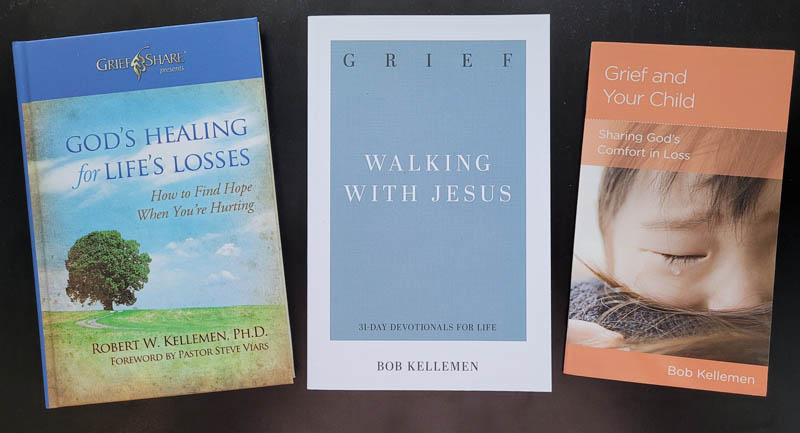
For additional help on your healing journey, learn more about God’s Healing for Life’s Losses: How to Find Hope When You’re Hurting.

Tags: , , ,

God’s Healing for Life’s Losses Seminar

Tuesday, October 25th, 2011

God’s Healing for Life’s Losses Seminar

When you, your family members, or friends are grieving over one of life’s many losses, where can you turn for help?

Saturday, November 5, 2011, Dr. Bob Kellemen will be presenting a God’s Healing for Life’s Losses seminar at New Hope Community Church, 5100 Bethesda Ct, Williamsburg, MI 49690 (219-938-8056).

Learn How To:

• Apply to your life a biblical approach to facing life’s losses with courageous honesty.

• Apply to your life a biblical approach to finding healing hope by finding God.

• Apply proven biblical principles to help hurting people to move through the biblical process of hurting and grieving: candor, complaint, cry, and comfort.

• Apply proven biblical principles to help hurting people to move through the biblical process of hope and growth: waiting, wailing, weaving, and worshipping.

• Build healing communities where Christians find courage and comfort in God and each other.

Attend the God’s Healing for Life’s Losses Seminar To:

• Experience personal healing and biblical hope.

• Encounter God in the midst of your suffering.

• Empathize with hurting people more compassionately.

• Encourage suffering people more competently.

• Empower your congregation to become a “hospital for the hurting.”

Sponsored By:

• WLJN Christian Radio, The Northwest Michigan Jesus Ministries, and New Hope Community Church

• Tickets are available at WLJN, 1101 Cass St, Traverse City MI 49685, 231-946-1400.

• Or call New Hope Community Church at: 219-938-8056.

Seminar Registration:

• Cost: $15.00 per person.

• Cost Includes: The seminar, God’s Healing for Life’s Losses book, seminar workbook, continental breakfast, and light lunch.

• Payment Methods: Check or cash.

• Day of the Seminar: The cost will be $20.00 per person.

Seminar Schedule:

• 8:30-9:00: Registration and Continental Breakfast

• 9:00-10:00: Session One: Launching the Journey of Grief: Honesty with Yourself and with God—Candor and Complaint

• 10:00-10:15: Break

• 10:15-11:15: Session Two: Inviting God to Join Your Journey: Finding God Even When You Can’t Find Answers—Cry and Comfort

• 11:15-11:30: Break

• 11:30-12:30: Session Three: Deepening Your Journey During the Dark Night of the Soul: On the Road to Hope—Waiting and Wailing

• 12:30-1:30: Lunch Provided

• 1:30-2:30: Session Four: Traveling with God on the Journey of Faith: Joining the Larger Story—Weaving and Worshipping

Tags: , , , ,

Is It Possible to Hope Again?

Monday, August 22nd, 2011

Is It Possible to Hope Again?

When life crushes the dreams we dream, is it possible to hope again? Hope is about perspective. As I often say, “when life stinks, our perspective shrinks.” We can learn to hope again by weaving in another way of looking at life.

Biblical weaving is entrusting myself to God’s larger purposes, good plans, and eternal perspective. I see life with spiritual eyes instead of eyeballs only. I look at suffering, not with rose colored glasses, but with faith eyes, with Cross-eyes, with 20/20 spiritual vision.

Joseph’s Story: “Life Is Bad, But God Is Good” 

Recall Joseph’s words to his fearful family in Genesis 50:19-20.

Don’t be afraid. Am I in the place of God? You intended to harm me, but God intended it for good to accomplish what is now being done, the saving of many lives.

Joseph uses “intended” both for his brothers’ plans and God’s purposes. The Hebrew word has a very tangible sense of to weave, to plait, to interpenetrate as in the weaving together of fabric to fashion a robe, perhaps even Joseph’s coat of many colors.

The Old Testament also used the word in a negative, metaphorical sense to suggest a malicious plot, the devising of a cruel scheme. Other times the Jews used “intended” to picture symbolically the creation of some new and beautiful purpose or result through the weaving together of seemingly haphazard, miscellaneous, or malicious events.

“Life is bad,” Joseph admits. “You plotted against me for evil. You intended to spoil or ruin something wonderful.”

“God is good,” Joseph insists. “God wove good out of evil,” choosing a word for “good” that is the superlative of pleasant, beautiful. That is, God intended to create amazing beauty from seemingly worthless ashes for those who grieve (Isaiah 61:3).

Grace Narratives: Weaving Truth into Life

Joseph discovers healing through God’s grace narrative. Further, he offers his brothers tastes of grace.

And now, do not be distressed and do not be angry with yourselves for selling me here, because it was to save lives that God sent me ahead of you. For two years now there has been a famine in the land, and for the next five years there will not be plowing and reaping. But God sent me ahead of you to preserve for you a remnant on earth and to save your lives by a great deliverance. So then, it was not you who sent me here, but God. He made me father to Pharaoh, lord of his entire household and ruler of all Egypt (Genesis 45:5-8).

Amazing! I hope you caught the words. “To save lives,” “to preserve,” “by a great deliverance.” That’s a grace narrative, a salvation narrative. Had God not preserved a remnant of Abraham’s descendants, then Jesus would never have been born.

Joseph uses his spiritual eyes to see God’s great grace purposes in saving not only Israel and Egypt, but also the entire world.

I hope you also caught Joseph’s repetition. “God sent me.” “God sent me ahead of you.” “It was not you who sent me here, but God.” Joseph sees the smaller story of human scheming for ruin. However, he also perceives that God trumps that smaller scheme with His larger purpose by weaving beauty out of ugly.

Life hurts. Wounds penetrate. Without grace narratives, hopelessness and bitterness flourish. With a grace narrative, hope and forgiveness flow and perspective grows.

Instead of our perspective shrinking, suffering is the exact time when we must listen most closely, when we must lean over to hear the whisper of God. True, God shouts to us in our pain, but His answers, as with Elijah, often come to us in whispered still small voices amid the thunders of the world.

The Rest of the Story

Return for the second half of the story of hope when we move from Grace Narratives to Grace Math: Divine Calculations.

Join the Conversation

How could you look at your suffering not with rose-colored glasses, but with faith eyes, with Cross-eyes, with 20/20 spiritual vision?

Note: This post is summarized from chapter eight of God’s Healing for Life’s Losses: How to Find Hope When You’re Hurting.

Tags: ,

Blessed Are Those Who Mourn

Wednesday, August 10th, 2011

Blessed Are Those Who Mourn 

In a recent Ask the Counselor post, I addressed the question, “Should I try to forget my past?” I said a hearty, biblical “No!”

I also said that one biblical response to our past is “reflection”: honestly facing our past face-to-face with Christ. In God’s Healing for Life’s Losses, I call that “candor.” Here’s an excerpt from chapter two: “Candor: Blessed Are Those Who Mourn.” 

Candor: Telling Your Self the Truth

The world has its way of grieving. But, when our fallen world falls on us, when suffering crushes us, we need much more than research. We need revelation—we need God’s inspired truth about how to grieve as those who have hope.

God’s Word offers us profound practical wisdom for moving from denial to candor. What exactly is biblical candor? Candor is courageous truth telling to myself about life in which I come face-to-face with the reality of my external and internal suffering. In candor, I admit what is happening to me and I feel what is going on inside me.

My Personal Candor Journey

I had to move from denial to candor after the death of my father on my 21st birthday. In fact, it was not until my 22nd birthday that the process truly began. I had been handling my loss like a good Bible college graduate and seminary student—I was pretending!

On my 22nd birthday, one year to the day after my father’s death, I went for a long walk around the outskirts of the seminary campus. That day I started facing my loss of my Dad. The reality that I would never know him in an adult-to-adult relationship. The fact that my future children would never know their grandfather.

As I faced some of these external loses, the tears came. Then I began to face some of the internal crosses—what was happening in me. I felt like a loner. Fatherless. Orphaned. Unprotected. On my own. The tears flowed. The process of candor began. The floodgate of emotions erupted. I was being honest with myself.

Biblical Candor Samplers: Fearlessly Facing the Facts

But was it biblical? Does God really allow and even invite His children to be brutally honest about life? Can we support candor biblically?

David practices candor in Psalm 42:3-5.

My tears have been my food day and night, while men say to me all day long, “Where is your God?” These things I remember as I pour out my soul: how I used to go with the multitude, leading the procession to the house of God, with shouts of joy and thanksgiving among the festive throng. Why are you downcast, O my soul? Why so disturbed within me?

Notice that David is honest about his external suffering. He describes his losses—the loss of fellowship, leadership, and worship. He also is candid about his internal suffering. He depicts his crosses—accurately labeling his soul as downcast and disturbed within him.

Job consistently models candor throughout his response to his losses.

What I feared has come upon me; what I dreaded has happened to me. I have no peace, no quietness; I have no rest, but only turmoil (Job 3:25-26).

Again we witness brutal frankness both about external losses and internal crosses.

We could profitably examine the accounts of other biblical characters who practiced candor—Jeremiah, Solomon, Asaph (Psalm 73), Heman (Psalm 88), Jesus, Paul, and so many more. They all convey the same inspired message: it’s normal to hurt and necessary to grieve.

The Apostle Paul does not tell us not to grieve; he tells us not to grieve without hope (1 Thessalonians 4:13). He chooses a Greek word meaning to feel sorrow, distress, and grief, and to experience pain, heaviness, and inner affliction.

Paul is teaching that grief is the grace of recovery because mourning slows us down to face life. No grieving; no healing. Know grieving; know healing.

The only person who can truly dare to grieve, bear to grieve, is the person with a future hope that things will eventually be better. When we trust God’s good heart, then we trust Him no matter what. We need not pretend. We can face and embrace the mysteries of life.

On the Road to Hope

Candor or denial. The choice is a turning point. It is a line drawn in the sand of life, a hurdle to confront.

Faith crosses the line. Trust leaps the hurdle. We face reality and embrace truth, sad as it is. If facing suffering is wrestling face-to-face with God, then candor is our decision to step on the mat. Will you?

Join the Conversation

True faith faces all of life face-to-face with Christ. Where would you put yourself on a scale of 1-10, with 1 being total denial and 10 being facing all of life—internal and external suffering?

Tags: , , ,

Ask the Counselor: “Should I Try to Forget My Past?”

Monday, August 8th, 2011

Ask the Counselor: “Should I Try to Forget My Past?”

As a biblical counselor, people often ask me the important question, “Should I try to forget my past?”

I first respond with a one-word answer. “No.”

Then I respond with a blog-size answer using the words:

• Remember

• Reflect

• Repent/Receive/Renew

• Reinterpret

• Retell

• Resources

Remember

Even if we wanted to, we couldn’t forget the past. It’s impossible. More importantly, it’s ungodly.

Memory is our God-given capacity to store and recall what we have experienced and learned. Remembering is part of our design by creation—before the fall into sin. “Remember” is used 167 times in the Bible (NIV), thus reminding us of the importance of remembering.

Some people mistakenly interpret Philippians 3:13 to mean that we should try to forget our past. “Forgetting what is behind and straining toward what is ahead.” The Greek word for “forget” does not mean not to remember, but not to focus my attention on. More importantly, the biblical context is whether Paul would focus his attention on his works of the flesh, attempts at self-righteousness, and putting confidence in the flesh, versus focusing on Christ’s righteousness and the power of Christ’s resurrection.

Paul’s second letter to the Corinthians is a testimony to the biblical value of remembering. “We do not want you to be uninformed, brothers, about the hardships we suffered in the province of Asia” (2 Cor. 1:8a). Throughout the epistle, Paul recalls and rehearses a litany of past suffering.

Reflect

In a similar way, the Psalms are a biblical testimonial to the power and value of remembering face-to-face with God. I call it reflecting.

People typically ask about forgetting in the context of dealing with past suffering—being sinned against, or dealing with past sin—sinning against others. I believe that attempting to refuse to remember our past can actually be a symptom of sin.

Trying to suppress past memories of pain (either regarding our suffering or sin) can be a refusal to face and deal with life. It can be an attempt to deal with pain apart from God. We could compare such attempts to self-sufficient “coping mechanisms” such as drinking and drugs—where we try anything to numb our pain, emptiness, or guilt.

In my book, God’s Healing for Life’s Losses, I describe how the Psalmists, Job, Jeremiah, Jesus, and Paul remember face-to-face with Christ through “candor and complaint/lament.” In biblical candor, we’re honest with ourselves regarding our past and present. In biblical complaint/lament, we’re honest with God regarding our past and present.

Rather than attempting to forget, we are to bring to mind past external events and our current internal thoughts and feelings and bring them to Christ. As I put it in the book, “No grieving, no healing. Know grieving, know healing.” Reflecting on our past is our admission to ourselves and God that we can’t handle our past on our own, that we desperately need Christ.

Repent, Receive Grace, Renew

When our memories of the past relate to our past sin, Christ’s soul-u-tion is to remember, repent, and receive grace. “Remember the height from which you have fallen! Repent and do the things you did at first” (Rev. 2:5).

In Psalms 32 and 51, David models remembering, repenting, receiving grace, and renewing his life by God’s Spirit. Rather than trying the impossible and sinful mental activity of suppressing the memory of his sin, David recalls to mind his sin against God. He repents deeply not only of behavioral sin, but of heart motivational sin.

Having repented, David receives grace—he accepts God’s gracious forgiveness and prays for shalom—a conscience at peace with the God of peace. He then prays that the Spirit would renew a right spirit within him so that he could turn from his path of sin (put off) and return to the path of righteousness (put on).

Reinterpret

But what do we do with our emotional agony when we remember past suffering—being sinned against? God’s Word is clear. We never forget, we re-member.

Think about that word: re-member. To put our memories back together again, to shape our memories through God’s eternal grid.

In God’s Healing for Life’s Losses, I use the life of Joseph to portray how God wants us to remember and then reinterpret our past with spiritual eyes. There I call it “weaving.”

In Genesis 50:20 and 45:4-8, Joseph refuses to forget. He calls to mind his suffering past with these words. “You intended to harm me, but God intended it for good to accomplish what is now being done, the saving of many lives.”

In the Hebrew, the word “intended” can be used in a physical sense for weaving together a tapestry, such as Joseph’s coat of many colors. It can be used in the metaphysical sense in a negative way for weaving together an evil scheme or plot, such as Joseph’s brothers did. Or, it can be used in a positive sense of God weaving together good out of evil.

How do we deal with our past suffering? We look at life with spiritual eyes by bringing to bear God’s eternal narrative, spiritual 20/20 vision, and larger story perspective. Weaving is re-membering—to create wholeness using God’s perspective to bring meaning to our suffering.

That’s how, like Joseph, we find hope when we’re hurting. That’s how, like Joseph, we grant forgiveness to those who have caused our suffering. In so doing we can say, “I grieve, but I don’t despair.”

Retell

Being human involves shaping our personal experiences into stories or narratives. That’s part of our God-given capacity of memory. We shape our sense of self and who we are in Christ from our retelling of our experiences.

As spiritual friends, it is when we listen carefully and compassionately to one another’s most important stories that we gain access to how our friends are attempting to make sense of themselves in the context of their past experiences. Our one-to-one relationships and our small group meetings should be places where we retell our stories.

In God’s Healing for Life’s Losses, I discuss how the retelling process moves us from “weaving” to “worshipping.” In worshipping we are committed to finding God even when we can’t find answers. We are committed to knowing God more than knowing relief from our past. We worship God by retelling our stories like Joseph did—in a way that honors and glorifies God and His role in redeeming our past (see Genesis 45:4-8).

There is no power in forgetting our past. God doesn’t want us to pretend. Of all people, as Christians we must be the most honest about our past. We must remember, reflect, repent/receive/renew, reinterpret, and retell.

Resources

Two biblical counseling resources that I think you will find helpful in dealing with your past are:

God’s Healing for Life’s Losses: How to Find Hope When You’re Hurting by Bob Kellemen.

Putting Your Past in Its Place: Moving Forward in Freedom and Forgiveness by Steve Viars.

Join the Conversation

What is your biblical answer to the question, “Should I try to forget my past?”

Tags: , , , ,

Five to Live By

Thursday, August 4th, 2011

Five to Live By

Linking you to the top 5 Christian blog posts of the week—posts that provide robust, rich, and relevant insights for living.

Where Is Christ in My Suffering?

Nancy Guthrie lost two children in infancy to Zellweger Syndrome. Listen to her story of finding Christ’s hope in the midst of her suffering in Suffering and the Centrality of Christ

What If God Says “No”?

Dr. Bob Smith notes that we always hear people thanking God for “yes” answers to prayer. But how should we respond When God Says “No.”

Feeling Socially Isolated? 

David Powlison addresses what to do and how to respond when you are Feeling Socially Isolated

Where Do Your Thoughts Turn?

When your worst nightmare occurs, Where Do Your Thoughts Turn? Steve Clay of the Association of Biblical Counselors probes Psalm 46 for biblical answers and insights.

What Belongs in Love? 

“Love”—seems like a word we could define and describe. But Brad Hambrick asks and answers an important and intriguing question in What Belongs in Love? 

Join the Conversation

Which post impacted you the most? Why? What blog posts have you enjoyed this week that you want to share with others?

Tags: , , ,