Archive for the 'Grief' Category

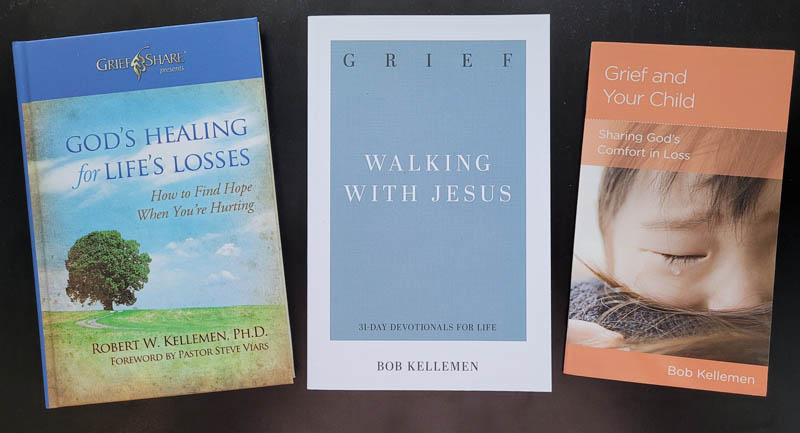
Three Dozen Quotes of Note on God’s Healing for Life’s Losses

Saturday, June 11th, 2011

Three Dozen Quotes of Note on God’s Healing for Life’s Losses 

Note: The following quotes are from God’s Healing for Life’s Losses: How to Find Hope When You’re Hurting. They are used with permission of BMH Books. The book is officially endorsed by GriefShare.

These are my personal favorites from the book—quotes that most impact my life. Feel free to use them in your life and ministry.

Quotes of Note for Finding Hope When You’re Hurting

“When tragedy strikes, we enter a crisis of faith. We either move toward God or away from God.”

“There is no human experience which cannot be put on the anvil of a lively relationship with God and man, and battered into a meaningful shape.”

“Christianity doesn’t in any way lessen suffering. It enables you to take it, to face it, to work through it, and eventually convert it.”

“God’s Word empowers us not to evade suffering, but to face suffering face-to-face with God.”

“In suffering, God is not getting back at you; He is getting you back to Himself.”

“Shared sorrow is endurable sorrow.”

“No grieving; no healing. Know grieving; know healing.”

“We live in a fallen world and it often falls on us.”

“The world is a mess and it messes with our minds.”

“Spiritual friendship with God results in 20/20 spiritual vision from God.”

“To deny or diminish suffering is to arrogantly refuse to be humbled. It is to reject dependence upon God.”

“Crying out to God empties us so there is more room in us for God.”

“Faith does not demand the removal of suffering; faith desires endurance in suffering.”

“Faith understands that what can’t be cured, can be endured.”

“Comfort experiences the presence of God in the presence of suffering—a presence that empowers me to survive scars and plants the seed of hope that I will yet thrive.”

“In this life, your scar may not go away, but neither will His. He understands. He cares. He’s there.”

“Spiritual emergencies can produce spiritual emergence.”

“Faith looks back to the past recalling God’s mighty works. Hope looks ahead remembering God’s coming reward.”

“In Christ, loss is never final. Christ’s resurrection is the first-fruit of every resurrection.”

“When we wait on God, we cling to God’s rope of hope, even when we can’t see it.”

“Hope waits. Hope is the refusal to demand heaven now.”

“Waiting is refusing to take over while refusing to give up. Waiting refuses self-rescue.”

“In Christ, we move from victims to victors.”

“God is a ‘time God.’ He does not come before time. He does not come after time. He comes at just the right time.”

“Faith is entrusting myself to God’s larger purposes, good plans, and eternal perspective.”

“Faith is seeing life with spiritual eyes instead of eyeballs only.”

“Through faith, I look at suffering, not with rose colored glasses, but with faith eyes, with Cross-eyes, with 20/20 spiritual vision.”

“Instead of our perspective shrinking, suffering is the exact time when we must listen most closely, when we must lean over to hear the whisper of God.”

“True, God shouts to us in our pain, but His answers, as with Elijah, often come to us in whispered still small voices amid the thunders of the world.”

“God’s eternal, heavenly story doesn’t obliterate my earthly, painful story; it gives it meaning.”

“Grace math teaches us that present suffering plus God’s character equals future glory. The equation we use is the Divine perspective.”

“Worship is wanting God more than wanting relief.”

“Worship is finding God even when you don’t find answers.”

“Worship is walking with God in the dark and having Him as the light of your soul.”

“Every problem is an opportunity to know God better, and our primary battle is to know God well.”

“Problems can either shove us far from God or drag us kicking and screaming closer to Him.”

Join the Conversation

Which quotes are your personal favorites? Which ones most impact you? What other quotes bring you Christ’s comfort during times of suffering?

Tags: , , , ,

Suicide, Salvation, and Eternal Security

Thursday, June 2nd, 2011

Suicide, Salvation, and Eternal Security 

Ever since the publication of my book God’s Healing for Life’s Losses: How to Find Hope When You’re Hurting, I receive many emails, phone calls, and questions about grief. One of the most difficult questions I hear is from family members who have lost a loved one to suicide. 

The question often sounds something like this.

“We are confident that our mother (or father, brother, sister, daughter, son) was a Christian by faith in Christ. Yet we have heard some say that if a believer commits suicide they lose their salvation. What does the Bible say?”

Shared Sorrow Is Endurable Sorrow

Any response to this question must first, of course, address the grief and agony of the surviving family members. The loss of a loved one is always a legitimate cause for great grief. Loss by suicide heaps even more grief and pain upon a family.

Christians, in particular, seem to struggle with “permission to grieve.” That was one reason I wrote God’s Healing for Life’s Losses: to help Christians struggling with any life loss to understand that the Bible encourages grief and provides a way toward growth and healing hope.

Any response must also include the encouragement for the family to cling to Christ and to the Body of Christ. No one should suffer grief alone. As I say in the book, “shared sorrow is endurable sorrow.”

Salvation and Eternal Security

Regarding the specific question concerning a loved one’s eternal security, my response, in summary, usually sounds something like the following.

There is nothing in the Bible to indicate that a believer in Christ can ever lose their salvation, their eternal security. The Apostle Paul is clear that there is now therefore no condemnation to those who are in Christ Jesus (Romans 8:1). Paul continues in that chapter to state that nothing can separate us from the love of God in Christ, including death—by any means (Romans 8:28-39).

Jesus Himself guarantees us: “I give them eternal life, and they shall never perish; no one can snatch them out of my hand. My Father, who has given them to me, is greater than all; no one can snatch them out of my Father’s hand. I and the Father are one” (John 10:28-30). Jesus died to save us from our sins—every sin, including suicide.

Doubt and Faith

Further, even doubt and loss of hope is not an evidence of loss of faith. In Mark 9:24, we read of the father of a sick child who said to Jesus, “I believe, help me overcome my unbelief.” The rest of the passage indicates that this father had faith, though like all of us, he struggled to overcome his doubts.

The Apostle Thomas doubted, yet his doubt was mingled with faith—saving faith, belief in Christ (John 21:24-29). The Apostle Paul himself honestly admitted that he despaired of life and felt the sentence of death (2 Corinthians 1:8-9), yet no one would question his saving faith and eternal security in Christ.

The “Unpardonable Sin”

Some ask whether suicide might be the “unpardonable sin.” The only unpardonable sin is to willfully and permanently reject God’s offer of salvation through Jesus Christ (John 3:36).

Jesus Christ’s sacrificial death atones for all the sins of his people—past, present, and future (Romans 3:25). Believers in Christ enjoy God’s enduring and complete forgiveness for all their sins (2 Corinthians 5:18-19).

Join the Conversation

What additional biblical hope do you share with people concerning a Christian’s eternal security in Christ?

Tags: , , , ,

The Biblical Counseling Coalition Reviews God’s Healing for Life’s Losses

Sunday, May 29th, 2011

The Biblical Counseling Coalition Reviews God’s Healing for Life’s Losses 

I was honored when Brad Hambrick decided to review God’s Healing for Life’s Losses for the Biblical Counseling Coalition’s review site. To read the review at the BCC visit BCC Book Review of God’s Healing for Life’s Losses.

If you’ve like to order a copy at 35% off, or, if you’d like to order ten copies at 40% off (just $9.99) visit the RPM Ministries Store. To  read a free chapter online and learn more about the book, visit the RPM God’s Healing site. And to watch the video trailer visit the God’s Healing Book Trailer.

Book Details

• Author: Bob Kellemen

• Publisher: BMH Books (2010) (116 Pages)

• Category: Biblical Counseling, Grief, Suffering

• ISBN: 978-0-88469-270-6

• Retail Price: $14.99

• Reviewed By: Brad Hambrick

A Biblical Guide for Grieving with Hope

Grief is an experience that one out of every one person will face. Actually, it is worse than that. We all experience grief multiple times throughout our lives. Unfortunately, the more people we love the more times we will experience significant grief.

In the midst of the pain we often ask ourselves, “To love or not to love (if we have a Shakespearian bent)?” “Is it really worth it to love if it means having to hurt like this (if we talk normal)?” Either way, we are tempted to consider not loving as the better option. In our moments of pain and confusion it just feels safer.

Dr. Bob Kellemen has written an excellent book to guide us biblically and relationally through this difficult (and often repetitive) season of life. The quality of the book is such that it warrants an endorsement from GriefShare, an organization devoted to developing Christ-centered grief support groups. They have included Dr. Kellemen on their panel of experts for interviews shown in thousands of grief recovery groups across the world every week.

There are three aspects of the book that I would like to highlight. Each makes God’s Healing for Life’s Losses an excellent resource for every pastor’s, counselor’s, and friend’s library; and an excellent guide for the person seeking to find God’s hope in the midst of their grief and loss.

Formatted for Grief: A Gift-Book Format

First, the book is purposefully user-friendly, focused, and short (only 116 pages total). In the midst of grief, concentration is difficult and processing anything is hard. A grieving person could pick up this book and not feel intimidated. That is important.

There are more ways to display an understanding of one’s audience than cleverly articulating penetrating insight. Dr. Kellemen reveals his compassionate heart for grieving people by writing a book that is accessible to people in the midst of their pain.

In and Out of Grief: Your Journey with Christ

Second, this book offers biblical markers for the journey through grief rooted in a well-developed theology of suffering. While aware of Kubler-Ross’s stages of grief (denial, anger, bargaining, depression, and acceptance), Dr. Kellemen does not operate within this paradigm.

Instead, he offers eight “stages” (referred to as “markers on our journey with God”) rather than five (see bullets below). These are not merely three additional hoops to jump through. Whereas Kubler-Ross’s material has one final “positive” or hope giving stage—acceptance—after four heart-breaking stages, Dr. Kellemen traces the journey up out of grief in as much detail as he traces the journey down into the emotional struggle.

In each case, Dr. Kellemen walks with readers in their movement from the world’s typical “stage” to God’s pathway for growth in and through grief:

• From Denial to Candor: Blessed Are Those Who Mourn

• From Anger to Complaint: A Lament for Your Loss

• From Bargaining to Crying Out to God: I Surrender All

• From Depression to Comfort: God Comes

• From Regrouping to Waiting: When God Says “Not Yet”

• From Deadening to Wailing: Pregnant with Hope

• From Despairing to Weaving: Spiritual Mathematics

• From Digging Cisterns to Worshipping: Finding God

Taking Grief by the Hand: Grieving with Hope

Third, the book is very personal. Not “in your business” personal, but “walking with you” personal. It contains the story of Dr. Kellemen’s own experiences with grief and the testimony of many others—including scores of biblical characters and dozens of modern-day examples. More than this, Dr. Kellemen invites you into the book with guided reflection (suitable both for individual use and/or group interaction) embedded into the book.

If you take the time to reflect and record your thoughts as you read, you will have more than practical, biblical information when you finish the book. You will have a travelogue of your journey though grief that can serve as a precious memento and an encouraging refuge during those times when the pain of grief returns (holiday, birthdays, and other special occasions).

Biblical, Personal, and Healing: Refreshing Honesty

In reflecting on the overall impact of the book, I would echo the words of Garrett Higbee (President of Twelve Stones Ministries and Executive Director of Harvest Biblical Soul Care).

God’s Healing for Life’s Losses takes on traditional thoughts about grief and loss and turns them upside down. There is refreshing honesty about the pain of loss and the permission to be real with God and others as we embrace the mourning process together. This book is biblical, personal, and healing. I highly recommend it.”

Tags: , , , ,

Quotes of Note on Suffering and Comfort

Saturday, April 16th, 2011

Quotes of Note on Suffering and Comfort

Note: I’ve taken the following quotes of note from God’s Healing for Life’s Losses: How to Find Hope When You’re Hurting. These are my personal favorites that most impact my own life. Feel free to use them in your life and ministry.

“When tragedy strikes, we enter a crisis of faith. We either move toward God or away from God.”

“There is no human experience which cannot be put on the anvil of a lively relationship with God and man, and battered into a meaningful shape.”

“Christianity doesn’t in any way lessen suffering. It enables you to take it, to face it, to work through it, and eventually convert it.”

“God’s Word empowers us not to evade suffering, but to face suffering face-to-face with God.”

“In suffering, God is not getting back at you; He is getting you back to Himself.”

“Shared sorrow is endurable sorrow.”

“No grieving; no healing. Know grieving; know healing.”

“We live in a fallen world and it often falls on us.”

“The world is a mess and it messes with our minds.”

“Spiritual friendship with God results in 20/20 spiritual vision from God.”

“To deny or diminish suffering is to arrogantly refuse to be humbled. It is to reject dependence upon God.”

“Crying out to God empties us so there is more room in us for God.”

“Faith does not demand the removal of suffering; faith desires endurance in suffering.”

“Faith understands that what can’t be cured, can be endured.”

“Comfort experiences the presence of God in the presence of suffering—a presence that empowers me to survive scars and plants the seed of hope that I will yet thrive.”

“In this life, your scar may not go away, but neither will His. He understands. He cares. He’s there.”

“Spiritual emergencies can produce spiritual emergence.”

“Faith looks back to the past recalling God’s mighty works. Hope looks ahead remembering God’s coming reward.”

“In Christ, loss is never final. Christ’s resurrection is the first-fruit of every resurrection.”

“When we wait on God, we cling to God’s rope of hope, even when we can’t see it.”

“Hope waits. Hope is the refusal to demand heaven now.”

“Waiting is refusing to take over while refusing to give up. Waiting refuses self-rescue.”

“In Christ, we move from victims to victors.”

“God is a ‘time God.’ He does not come before time. He does not come after time. He comes at just the right time.”

“Faith is entrusting myself to God’s larger purposes, good plans, and eternal perspective.”

“Faith is seeing life with spiritual eyes instead of eyeballs only.”

“Through faith, I look at suffering, not with rose colored glasses, but with faith eyes, with Cross-eyes, with 20/20 spiritual vision.”

“Instead of our perspective shrinking, suffering is the exact time when we must listen most closely, when we must lean over to hear the whisper of God.”

“True, God shouts to us in our pain, but His answers, as with Elijah, often come to us in whispered still small voices amid the thunders of the world.”

“God’s eternal, heavenly story doesn’t obliterate my earthly, painful story; it gives it meaning.”

“Grace math teaches us that present suffering plus God’s character equals future glory. The equation we use is the Divine perspective.”

“Worship is wanting God more than wanting relief.”

“Worship is finding God even when you don’t find answers.”

“Worship is walking with God in the dark and having Him as the light of your soul.”

“Every problem is an opportunity to know God better, and our primary battle is to know God well.”

“Problems can either shove us far from God or drag us kicking and screaming closer to Him.”

Join the Conversation

Which quotes are your personal favorites? Which ones most impact you? What other quotes bring you comfort and encouragement during times of suffering?


Share


Tags: , , , , , ,

God’s Healing for Life’s Losses Video Book Trailer

Wednesday, April 6th, 2011

God’s Healing for Life’s Losses Video Book Trailer 

When life’s losses invade your world, learn how to face suffering face-to-face with God with God’s Healing for Life’s Losses: How to Find Hope When You’re Hurting.

Learn more about God’s Healing for Life’s Losses as you enjoy the video book trailer where I share about:

• Who should read God’s Healing for Life’s Losses—Hint: anyone who has ever suffered any loss.

• How God’s Healing for Life’s Losses is a very personal book for me

• The main message of the book

• How the book addresses all types of losses in life


Watch the video on our RPM Ministries YouTube Channel.

Visit our God’s Healing for Life’s Losses page to read a free sample chapter and learn how you can order an autographed copy of God’s Healing at 35% off.


Share


Tags: , , , ,

Healing for the Holidays: Part Eight—Pregnant with Hope

Friday, November 19th, 2010

Healing for the Holidays: Part Eight—Pregnant with Hope

Note: This is the sixth in a series of posts on Healing for the Holidays. Read Part 1: A Promise, Part 2: Give Sorrow Words, Part 3: Q/A About Holiday Honesty, Part 4: A Lament for Your Loss, Part 5: Tidings of Comfort and Joy, Part 6: All I Want for Christmas Is Hope, and Part 7: Clinging to God’s Rope of Hope.

What About the Three Easy Steps?

I counsel often with grieving people. I read a lot about grief. Articles that offer a few quick quips, three steps, or secrets to survival rarely provide lasting help for profoundly hurting people. Healing for the holidays requires God’s curing truth for our troubled souls. True grief recovery demands Truth from the Author of life. Nothing is more relevant because only the Creator and Lover of the soul knows what cures the soul.

Nowhere is this truer than with holiday healing. God’s Word shows us how to stay alive to life even when it tries to crush us to death. Through the Bible, God speaks to our wounded souls with words of life. As the great Soul Physician, Christ treats our labor pains by encouraging us to remain pregnant with hope. He teaches us to:

Long fervently for heaven and live passionately for God and others while still on earth.

Loving Hope, Hope That Loves

Paul personifies hope that loves in Philippians 1:23-25.

“I am torn between the two: I desire to depart and be with Christ, which is better by far; but it is more necessary for you that I remain in the body. Convinced of this, I know that I will remain, and I will continue with all of you for your progress and joy in the faith.”

Paul neither deadens his longing for heaven nor minimizes his calling on earth. Paul grieves the “not yet.” He hungers and thirsts; he longs and wants what is promised, but what he does not possess. As he writes, he’s jailed. Separated from all who love him. If anyone has an excuse to give up hope and to give up loving, it is the Apostle Paul.

But he chooses to remain pregnant with hope, to participate in loving hope, in hope that loves. He says, “I want to go home. This world is messed up. I ache for heaven, for Paradise. But I’m pulling weeds until the day I die! My grief is not excuse to ignore your growth. I’m living for your joy and spiritual progress.”

My Problem with Typical Grief “Remedies”

That’s other-centered grieving and groaning. And that’s why I have a boatload of problems with typical grief remedies, especially related to the holidays. In a desire to express empathy, writers on grief seem to start and stop with what we might call “self-care.” “Take care of yourself. Nurture yourself. Be good to yourself. Be patient with yourself.”

In perspective, there’s biblical wisdom in such cautions. I’ve tried to convey the same empathy throughout this series. But there are two pointed reasons not to stop with or focus on self.

1. The Bible teaches us to focus on others.

Enough said.

While the Bible never minimizes our hurt, it always maximizes hopeful loving. While Christ identifies with, feels, and even experiences our suffering, loss, and grief, He always encourages and empowers us to take the comfort we receive from Him and comfort others (2 Corinthians 1:3-6).

Do you long for profound healing for the holidays? Offer Christ’s healing hope to others.

2. Life teaches us to focus on others.

Research study after research study comes to the same conclusion. Healing comes when we start focusing on others.

History teaches us the same lesson. In my book Beyond the Suffering, I trace the amazing and inspiring legacy of the heroes of the Black Church. Despite horrific suffering and agonizing grief, men and women of the Black Church not only endured the suffering of enslavement, they moved beyond the suffering. How? By hoping in God and by loving one another—hope that loves. 

Thriving—In God’s Love

Where does hope that love come from? It comes from the God of love. In Romans 8:28-39, Paul insists that even in the midst of trouble, hardship, persecution, and suffering, nothing can separate us from the love of God in Christ Jesus. Paul teaches that in all our suffering we are more than conquerors through Him who loved us so.

“More than conquerors” comes from the Greek word nikao from which we gain our word “Nike”—victors, winners, Olympic champions. Being pregnant with hope empowers us to long ardently for heaven and to live victoriously on earth. Loving hope, hope that loves, moves us from victims to victors in Christ.

On the Road to Hope

You’ve just encountered another choice point on the road to hope. At this fork in the road, you can turn one direction and choose the journey of living for self. Taking that route, your pain never goes away; it’s just buried beneath any number of self-centered diversions.

Or, you can choose the route of being pregnant with hope. You’ll feel the pain—the deep pain of grief, of being out of the nest, of living east of Eden, of longing fervently for heaven but living in our fallen world. However, you’ll experience the profound joy that accompanies living passionately for God and others. God’s Spirit will empower your spirit so that you can be more than a conqueror—now!

The Rest of the Story

Where do we find the faith to pursue love that hopes? We find it when we weave God’s eternal story into our earthly story of suffering. Join me in our next post for God’s wisdom from before the dawn of time.

Join the Conversation

Do you believe that in Christ you are more than a conqueror—able to offer others hopeful love even in the midst of your painful grief?

Help for Your Healing Journey

For additional help on your healing journey, learn more about God’s Healing for Life’s Losses: How to Find Hope When You’re Hurting. Also, visit GriefShare for information on their small group video series Surviving the Holidays.


Share


Tags: , , ,