Archive for the 'Women’s Studies' Category

Women of the Reformation, Part 4: Katherine von Bora Luther: Living the Truth in Love

Thursday, September 30th, 2010

Women of the Reformation, Part 4: Katherine von Bora Luther: Living the Truth in Love

The Big Idea: By celebrating the legacy of women heroes of the Reformation, we learn how to speak Gospel truth in love.

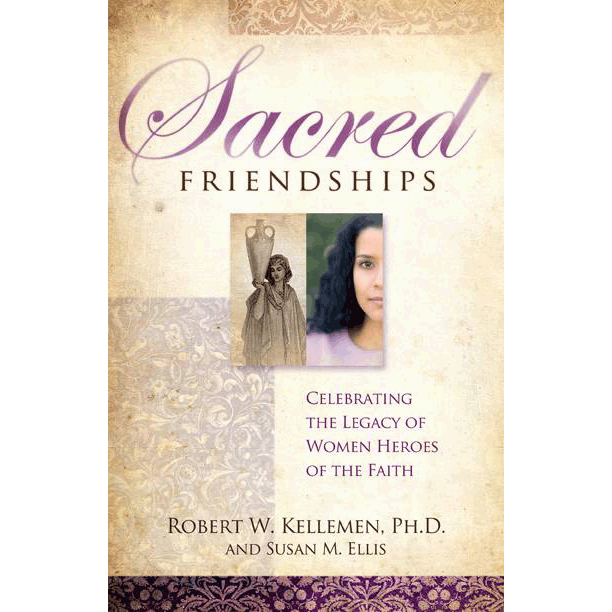
More Faith Stories: Read Part 1 Don’t Bury Your Talent. Read Part 2 Speaking Truth to Power. Read Part 3 Unfading Beauty. To learn life lessons from 52 women heroes of the faith, read Sacred Friendships, which is the source for today’s blog post. 

Katherine von Bora Luther: Living the Truth in Love

Katherine von Bora is the best known of all the women of the Reformation because she was Martin Luther’s wife. However, she was much more than that. Katherine was born in January 1499 in a little village near Leipzig. Her parents enjoyed a degree of financial security and unlike most girls her age she received an education, studying at a Benedictine school beginning at age six. At age ten, when her mother died and her father remarried, they sent Katherine to a Cistercian convent to prepare for solemn vows, eventually taking them when she was sixteen.

A Wagon Load of Vestal Virgins

In the early 1520s, Luther’s writings began to infiltrate monastic houses. “The sisters at Nimschen, nine of them, disquieted in conscience, sought his counsel. Luther advised escape and undertook to make the arrangements.”

Luther turned to a highly trusted layman, Leonard Kopp, who delivered barrels of smoked herrings to the nuns. Hidden in the covered wagon, they rumbled into Wittenberg. A student there wrote to a friend, “A wagon load of vestal virgins has just come to town all more eager for marriage than for life. May God give them husbands lest worse befall.”

Luther felt responsible that worse should not befall. All were placed either in teaching posts, in homes, or in matrimony. Katherine spent two years working in a home while Luther sought a husband for her. Finding no match, and at her initial suggestion, Luther agreed to marry Katherine because his marriage “would please his father, rile the pope, make the angels laugh and the devils weep, and would seal his testimony.” She was twenty-six; he was forty-two.

Though initially a marriage of convenience, they grew to love and depend upon each other profoundly. In fact, Luther would say of her, “In domestic affairs, I defer to Katie. Otherwise I am led by the Holy Ghost.” When he thought her at the point of death, he pleaded, “Don’t die and leave me.” Thirteen years after their marriage, Martin would say of Katherine, “If I should lose my Katie I would not take another wife through I were offered a queen.”

A Physician of the Soul

What was it about Katherine’s character and ministry that so endeared her to Luther? She “ministered to her husband’s diseases, depressions, and eccentricities.” Her son, later a physician, praised her as half a doctor. He could not have survived his depression, which he interpreted as satanic temptations to doubt God’s forgiveness, without her sustaining and healing ministry. At night he would turn over and plead with Katherine, “Forbid me to have such temptations.” Based upon Luther’s own methods of soul care for such depression, we can surmise that Katherine responded by ministering sustaining empathy and healing encouragement through spiritual conversations and scriptural explorations.

Luther’s own testimony further describes Katherine’s empathic care. Speaking from the experience of their marriage and parenting he writes:

“Marriage offers the greatest sphere for good works, because it rest on love—love between the husband and the wife, love of the parents for the children, whom they nourish, clothe, rear, and nurse. If a child is sick, the parents are sick with worry. If the husband is sick, the wife is as concerned as if it were herself. If it be said that marriage entails concern, worry, and trouble, that is all true, but these the Christian is not to shun.”

Undoubtedly, Martin frequently experienced Katherine’s as if compassion numerous times in his battles with depression.

Katherine was unafraid to lovingly rebuke Martin. When his language was too foul, she would say, “Oh come now, that’s too raw.” Luther’s Table Talks also disclose that Katherine at times prodded her husband to respond forcefully to unfair attacks and doctrinal error.

A Hospital for the Hurting

As with Idelette Calvin, Katherine’s ministry was not exclusively to her family. The Augustinian Cloister where Luther had lived as a monk was first loaned and then given to the couple by the Elector. It had on the first floor forty rooms with cells above. Eventually not a single room was unoccupied. A friend described the scene. “The home of Luther is occupied by a motley crowd of boys, students, girls, widows, old women, and youngsters.” Katherine “came to be a mistress of a household, a hostel, and a hospital.”

Luther recognized and appreciated her versatility and creativity. “To my dear wife Katherine von Bora, preacher, brewer, gardener, and whatsoever else she may be.” On other occasions he referred to her as “my kind and dear lord and master, Katy, Lutheress, doctoress, and priestess of Wittenberg.” Yet again, ten years after they married, he had this description. “My lord Kate drives a team, farms, pastures, and sells cows . . . and between times reads the Bible.”

Sticking to Christ

But for Katherine, reading the Bible was insufficient. She longed to apply it. “I’ve read enough. I’ve heard enough. I know enough. Would to God I lived it.”

Such was her testimony to her dying day. Ill for three months after an accident landed her on her back in a ditch filled with icy water, Katherine died on December 20, 1550, at age fifty-one. The final words from her lips depict how she lived her entire life. “I will stick to Christ as a burr to a top coat.” The last words of Idelette Calvin and Katherine von Bora Luther each communicate that they were not simply wives of Reformers, but more so daughters of the King of King.

Join the Conversation

Which aspect of Katherine’s life most powerfully impacts you?


Share


Tags: , , , ,

The Road to Hope: Perpetua’s Story

Thursday, September 9th, 2010

The Road to Hope: Perpetua’s Story

Note: The following post originally appeared in Sacred Friendships: Celebrating the Legacy of Women Heroes of the Faith which tells the story of over fifty remarkable Christian women. For Part One of this two-part post, read Not Your Father’s Church History.

“As If” Empathy

On the day of Perpetua’s final hearing before being martyred for her faith in 203 AD, the guards rushed Perpetua to the prisoners’ platform. Her father appeared with her infant son, trying to guilt her by imploring her to “have pity on your son!” He caused such an uproar, that the Governor ordered him thrown out, and he was beaten with a rod.

Perpetua writes of this horrible incident. “My father’s injury hurt me as much as if I myself had been beaten. And I grieved because of his pathetic old age.” Perpetua provides a classic portrait of biblical empathy. Her as if experience of her father’s pain is the essence of sustaining soul care—making the agony of others our very own.

Words of Life While Facing Death

Perpetua not only finds in Christ the strength to empathize with her father, she also summons Christ’s power to console and encourage her family and her fellow martyrs.

“In my anxiety for the infant I spoke to my mother about him, tried to console my brother and asked that they care for my son. I suffered intensely because I sensed their agony on my account. These were the trials I had to endure for many days.”

Incredibly, Perpetua’s greatest pain was her ache for others who hurt for her!

A few days passed after the hearing and before the battle in the arena commenced. During this interval, Perpetua witnessed to her persecutors and ministered to other detainees.

“Pudens, the official in charge of the prison (the official who had gradually come to admire us for our persistence), admitted many prisoners to our cell so that we might mutually encourage each other.”

Facing death, Perpetua shared words of life with all who would listen.

Maintaining Perpetual Persistence

Felicitas (Perpetua’s friend and fellow prisoner) was in her eighth month of pregnancy. As the day of the contest approached, she became very distressed that her martyrdom might be delayed, since the law forbade the execution of a pregnant woman. An eyewitness to their eventual death shares his account of their journey together.

“Her friends in martyrdom were equally sad at the thought of abandoning such a good friend to travel alone on the same road to hope. And so, two days before the contest, united in grief they prayed to the Lord.” Immediately after their prayers, her labor pains began and Felicitas gave birth to a girl whom one of her sisters reared as her own.

This eyewitness records their witness for Christ to the very end.

“On the day before the public games, as they were eating the last meal commonly called the free meal, they tried as much as possible to make it instead an agape. In the same spirit they were exhorting the people, warning them to remember the judgment of God, asking them to be witnesses of the prisoners’ joy in suffering, and ridiculing the curiosity of the crowd. . . . Then they all left the prison amazed, and many of them began to believe.”

To the very end, Perpetua maintains her perpetual persistence.

“The day of their victory dawned, and with joyful countenances they marched from the prison to the arena as though on their way to heaven. If there was any trembling, it was from joy, not fear. Perpetua followed with a quick step as a true spouse of Christ, the darling of God, her brightly flashing eyes quelling the gaze of the crowd.”

Stubbornly Resisting to the End

As they were led through the gates, they were ordered to put on different clothes; the men, those of the priests of Saturn, the women, those of the priestesses of Ceres. Of Perpetua we are told:

“But that noble woman stubbornly resisted even to the end. She said, ‘We’ve come this far voluntarily in order to protect our rights, and we’ve pledged our lives not to recapitulate on any such matter as this. We made this agreement with you.’ Injustice bowed to justice and the guard conceded that they could enter the arena in their ordinary dress. Perpetua was singing victory psalms as if already crushing the head of the Egyptian.”

Here we witness not only Perpetua’s courageous example of persistence, but also her model of biblical confrontation. She provides riveting testimony to Christ’s power at work in the inner life of a Christian woman whose spirit could never be overpowered.

Join the Conversation

Why is Perpetua’s willingness to sacrifice all for God so seldom seen in modern Christianity?

The Martyrdom of Perpetua


Share


Tags: , , , ,

Not Your Father’s Church History

Wednesday, September 8th, 2010

Not Your Father’s Church History

Note: The following post originally appeared in Sacred Friendships: Celebrating the Legacy of Women Heroes of the Faith which tells the story of over fifty remarkable Christian women.

Listening to the Silenced Voices

For far too long, church history has been told as HIS-story. The strong, empowering voices of women have been silenced. It’s a sad pattern that we can trace back all the way to Hagar.

Fortunately, a fair and balanced narrative of church history shows that women have always spoken God’s truth in love to change lives with Christ’s changeless truth. For two-thousand years women have engaged in gospel conversations to minister to hurting and hardened people. It’s time for church history once again also to be Her-story.

Giving Voice to the Voiceless

When we think of the early church, our minds focus on the Church Fathers. Sadly, we normally fail even to consider the Church Mothers. Yet, these godly women heroically waged spiritual warfare against the world, the flesh, and the devil.

Their loses and their victories, their pain and their joy, their walk with Christ and their journey with one another are all an inheritance from which each of us are eligible to draw. There is a mighty company of gallant women believers from whom we can learn.

Vibia Perpetua: From Victim to Victor

Vibia Perpetua (181-203) heads that company. The early Church preserved her manuscript, The Martyrdom of Perpetua, as a martyr’s relic because it is one of the oldest and most descriptive accounts of death for Christ. It is also the earliest known document written by a Christian woman. Anyone who has ever suffered for the faith or has been oppressed by the powerful can carry on a conversation and feel a bond with Perpetua. In fact, in the introduction to her story, we read that she wrote it “expressly for God’s honor and humans’ encouragement” to testify to the grace of God and to edify God’s grace-bought people.

Of course, even reading the word “martyr” likely causes us to imagine that Perpetua was a spiritual “super woman” whose life and ministry we could not possibly emulate. The story of her life, however, demonstrates just the opposite.

The Story of Her Life

Perpetua lived in Carthage in North Africa during the persecution of Christians under Septimius Severus. At the time of her arrest in 202 AD, she was a twenty-one-year-old mother of an infant son. Born into a wealthy, prominent, but unbelieving family, she was a recent convert with a father who continually attempted to weaken her faith and a husband who was, for reasons unknown to us, out of the picture. Nothing in Perpetua’s situation or background prepared her for the titanic spiritual struggle God called her to face.

Perpetua, her brother, her servant (Felicitas), and two other new converts were discipled by Saturus. We learn from Perpetua of the arrest of all these faithful followers of Christ.

“At this time we were baptized and the Spirit instructed me not to request anything from the baptismal waters except endurance of physical suffering. A few days later we were imprisoned.”

A Light in the Darkness: Experiencing the Pain of Others

Perpetua candidly faces her fears and expresses her internal and external suffering.

“I was terrified because never before had I experienced such darkness. What a terrible day! Because of crowded conditions and rough treatment by the soldiers the heat was unbearable. My condition was aggravated by my anxiety for my baby.”

This very human woman exudes superhuman strength. In the midst of her agony, she empathizes with and consoles others. Her father, completely exhausted from his anxiety, came from the city to beg Perpetua to recant and offer sacrifice to the emperor.

“I was very upset because of my father’s condition. He was the only member of my family who would find no reason for joy in my suffering. I tried to comfort him saying, ‘Whatever God wants at this tribunal will happen, for remember that our power comes not from ourselves but from God.’ But utterly dejected, my father left me.”

The Rest of the Story

To learn what happens to Perpetua and her friends, read part two of Perpetua’s life in my next blog post: The Road to Hope.

Join the Conversation

Why do you think we have silenced the voices of godly women in church history?

The Martyrdom of Perpetua


Share


Tags: , , ,

Rock Solid Narrative

Wednesday, October 7th, 2009
Rock Solid Narrative


As the Sacred Friendships Blog Tour nears its halfway point, Rick Howerton over at Serendipityblog.com posted his review today. You can also link to him via this shortcut: http://bit.ly/2DlqSW

Among other insights, Rick calls Sacred Friendships “rock solid narrative.”

See what else Rick has to say at http://bit.ly/2DlqSW

If you’d like an autographed copy at 40% off, please visit: http://bit.ly/MG1l5

Tags: , , ,

Blog Tour Day Three: Podcast Interview

Wednesday, September 23rd, 2009
Sacred Friendships Blog Tour Day Three
For day three of the Sacred Friendships Blog Tour, check out Stacy Harp’s podcast interview of me at:

http://stacylynnharp.blogspot.com/ and http://www.blogforbooks.com/

Here’s part of what Stacy says on her blogs:

“And let me also tell you this, if you want a book that is going to build your faith, is easy to read, and inspiring, this is a great read. I’ve been reading my copy and love it….and Bob did not pay me to tell you that!”

Tags:

Sacred Friendships Blog Tour

Thursday, September 10th, 2009

Sacred Friendships Blog Tour

Whew! It’s a lot of work organizing a blog tour.

But…it’s also a lot of fun…and it provides a great excuse for re-connecting with old friends and making fresh connections with new friends.

So…we have 30 stops on our Sacred Friendships Blog Tour. Every Monday-through-Friday, September 21 to October 30, for six weeks, someone new will be blogging about Sacred Friendships.

Some will do Podcast interviews.

Some will do full book reviews–and they can say anything they think, no strings attached.

Some will review portions of the book.

Some will have Susan Ellis and me respond to their own Author Interview Q/As.

Some will post excerpts from the Author Q/As Susan and I prepared.

A few days before each blog post, I’ll list the web address, and then list it again, so people can be sure to visit.

And…get involved. Five people who comment on any of the blog sites will be randomly selected to receive a free, autographed copy of Sacred Friendships.

Many thanks to all my blogging friends new and old who have agreed to give of their valuable time and blog space to join the journey.

By the way…I pick up copies of the book tomorrow from BMH Books!

Have you ordered your very own copy yet? Here’s your link: http://bit.ly/MG1l5

Be empowered and have your life changed by the amazing stories of over 50 remarkable women. You’ll never think about ministry the same again.

Bob

PS: Are you an author and you’d like to learn about blog tours? Well, I’m a “rookie” just one month ahead on the journey, but I love helping others to succeed. So…whatever I’ve learned and will learn along the way, I’m glad to share. Email me your questions: rpm.ministries@gmail.com