Tag Archive
Al Mohler A New Kind of Christianity Anxiety Beyond the Suffering Biblical Counseling Biblical Counseling Coalition Black Church History Black History Month Book Review CCEF Christian Counseling Christmas Church Discipleship Emotional Intelligence Emotions Equipping Equipping Counselors for Your Church God's Healing God's Healing for Life's Losses Gospel Coalition Grief GriefShare Grieving Healing for the Holidays Kellemen Luther Martin Luther Ministry Pastoral Ministry Pastors Quotes Reformation RPM Ministries Sacred Friendships Soul Care Soul Physicians Spiritual Direction Spiritual Formation Spiritual Friends Suffering The Best of the Best The Journey Tim Challies Video
The Final 5 Free Disciple-Making Resources from Equipping Counselors for Your Church
Note: This is the fourth and final post in a series of blogs where I’m giving away eighteen free resources from the Appendix of my book Equipping Counselors for Your Church. For links to the first three resources, visit Part One, for links to another seven resources, visit Part Two, and for links to three more resources, visit Part Three. 
Appendix 10.1: Biblical Counseling Trainee Assessments
With Appendix 10.1, you can view and use sample assessments (tests, evaluations, final projects) used to evaluate how well each trainee has learned the “4Cs” of content, character, competence, and community.
Appendix 10.2: Biblical Counseling Sample Lesson Objectives and Outlines
What does an actual “training time” with trainees look like? Appendix 10.2 shows you with its sample lesson objectives and robust lesson outline.
Appendix 11.1: Biblical Counseling Ministry Policy and Procedure Manual
Appendix 11.1 is the document many have been waiting for. It’s an Appendix within an Appendix. In fact, it’s a book within a book. It’s twenty-six pages! It contains every sample form imaginable for overseeing your biblical counseling ministry. It provides every sample form you will need to “organize the organism”—establishing the structure you need to supervise and mentor each trainee and to build your ministry from good to great.
Appendix 11.2: Biblical Counseling Ministry Evaluation Form
How do you evaluate whether your training is effective? How to you assess what to improve and how? Appendix 11.2 shows you how.
Appendix 12.1: Church Discipline Policy
What’s the relationship between biblical counseling and church discipline? What is a biblical church discipline policy? Appendix 12.1 addresses those questions and more.
Enjoy!
What’s Next?
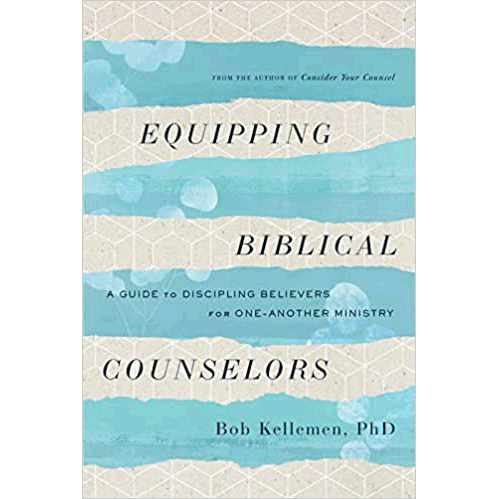
If these resources are beneficial to you, then consider purchasing and using Equipping Counselors for Your Church in your church ministry, para-church ministry, and educational setting. At the Equipping Counselors’ page, you will find a sample chapter, quotes, recommendations, the book video trailer, links to all the resources, and a link to order your personal copy.
Join the Conversation
How do you oversee and administrate your biblical counseling ministry once you’ve equipped biblical counselors for your church? How do you supervise and mentor your local church biblical counselors once you’ve equipped them?
3 More Free Disciple-Making Resources from Equipping Counselors for Your Church
Note: This is the third in a series of posts where I’m giving away free resources from the Appendix of my book Equipping Counselors for Your Church. For links to the first three resources, visit Part One and for links to another seven resources, visit Part Two. 
Appendix 5.1: A Formal Vote
In Equipping Counselors for Your Church, I explain that whether or not your church government is congregational, there are benefits that arise from having your congregation affirm the launch of your formal biblical counseling ministry (see chapter 5). Appendix 5.1: Formal Vote/Affirmation provides sample wording for such congregational affirmation.
Appendix 6.1: Biblical Counseling Information Packet
Chapter 6 of Equipping Counselors for Your Church highlights the “enlisting” process. Appendix 6.1: Biblical Counseling Information Packet is a twenty-page document with seven forms that provide what you need to enlist and “recruit” people to your biblical counseling ministry.
Appendix 7.1: Biblical Counseling Goals and Objectives
Chapter 7 of Equipping Counselors for Your Church details the biblical goals of a biblical counseling equipping ministry. Appendix 7.1: Biblical Counseling Goals and Objectives summarizes those goals and objectives.
Enjoy!
Coming Soon
Our fourth and final set of Appendix resources from Equipping Counselors for Your Church will include five Appendix documents, including the robust Biblical Counseling Ministry Policy and Procedure Manual.
Join the Conversation
How have you selected and enlisted people for “formal” biblical counseling training in your church?
Three Free Disciple-Making Resources from Equipping Counselors for Your Church
My passion in writing Equipping Counselors for Your Church was to follow 2 Timothy 2:1-2.
“You then, my son, be strong in the grace that is in Christ Jesus. And the things you have heard me say in the presence of many witnesses entrust to reliable men who will also be qualified to teach others.”
I want to be a part of equipping equippers of equippers. 
Free Resources from Equipping Counselors for Your Church
I’m sometimes criticized for all the “free stuff” that I “give away.” People say, “But Bob, don’t you know that you could sell that as an e-doc?”
Yes, I know. And, I do sell stuff. Nothing wrong with that.
But equipping equippers is such a serious calling on my life, that anytime I can share free resources, I will do so.
So, starting today, I am uploading sections of the Appendix materials from Equipping Counselors for Your Church that you can download for free. Some have said, “The Appendix alone is worth the price of the book!” Well, you can still buy the book! But I do agree that the material in the Appendix is valuable.
Here’s What You Can Download Today
Today you can download for free:
1. A PDF of the Appendix Table of Contents so you have a glimpse into what’s coming: 17 Appendix documents providing best-practice, how-to material.
2. A PDF of Appendix 1.1: A Listing of the 24 Best-Practice Disciple-Making Champions. Learn about two dozen churches and para-church groups who are already equipping God’s people for one-another ministry.
3. A PDF of Appendix 2.1: Congregational SWORD Heart Exam. Download a congregational assessment sampler. Learn how to assess the heart health of your congregation and the readiness of your congregation for one-another ministry.
Enjoy!
Coming Soon
Our next set of resources will include seven free downloads, all related to catching and casting God’s mission and vision for your congregation and ministry. They will include five sample mission/vision statements, plus two sample guides for facilitating a biblical discussion of mission and vision.
Join the Conversation
In the business world, they have their SWOT Analysis. Resource 3 is my SWORD Heart Exam. In what ways is SWORD more appropriate for church ministry than SWOT?
Change Management, Part 1: Shepherding the Transformation
Note: I’m developing this blog mini-series from material in chapter five of my book Equipping Counselors for Your Church.
An Exercise in Change
When I teach and consult on change management, I start with a change exercise. I ask participants to stand and face each other in pairs of two, observing each other’s appearance. Then I instruct them to turn back to back and make five changes to their appearance. Typically, they roll up a sleeve, take off their glasses, loosen a tie, remove an earring, or make other basic changes.
Next I tell them to face each other and identify the five changes their partner made. They’ll laugh, point out changes, and instinctively start to change back.
Before they do, I ask them to turn around again and make five additional changes to their appearance. From some people I hear murmuring; from others I observe enthusiastic creativity. Hair braids come off, pant legs are pulled up, jackets are put on backwards, pens are placed over an ear, shirttails come out. Once again they face each other and identify these changes.
Then I start to say, “Okay, turn around again…” Vocal resistance begins. I respond, “Just kidding. Let’s sit down and talk about our CQ—our Change Quotient.” We then discuss:
• Were you comfortable or uncomfortable with the assignment?
• Were the changes easy or hard for you to make? To identify?
• Were you in a cooperative mode or a mutiny mood?
• At what point, if any, did you experience change overload?
• How quickly did you revert back to your former look?
We then discuss the implications that we can derive for change management. People mention applications such as:
• Change takes an initiator.
• The initiator of change must be trusted.
• Change requires clear instructions.
• People can handle only so much change—don’t overload.
• Change takes energy and creativity.
• Change can be minor yet feel dramatic.
• Change can cause people to feel uncomfortable and even fearful about losing the old and facing the new.
• People focus on what they have to sacrifice.
• People feel isolated when they lose the familiar.
• People have different levels of readiness for change.
• Change is not one action but a journey. People often revert back to their old style.
Shifting Teutonic Plates
If a little game like this prompts such turmoil, imagine the angst when we ask a congregation to make a major ministry mindset shift. For many congregations, it’s a monumental shift to move from the pastor as the doer of ministry to the pastor as the equipper of equippers. For many church members, it’s a massive shift to move from receiving counseling from the pastor to providing counseling to one another.
This is why it’s unwise to move directly from a new vision to enlisting people to live out that vision. Yet we do it all the time. We get all excited after attending a seminar on Gospel-centered preaching, or the disciple-making pastor, or the equipping-focused church. Then we return home, gather other likeminded people, create a vision statement, tell others about it, and announce a grand new approach to church life.
Instead of creating a following, we generate a family feud.
Been There, Done That
I know, because I just described my experience. Armed with the best of intentions, but not with the greatest wisdom, I tried to shift our congregation from a pastor-centered model to an equipping-centered approach. I made enough mistakes and learned enough from those mistakes to write a book.
My heart was right—I wanted to transform the way our congregation lived the Gospel. My initial process was wrong—I expected people to make dramatic changes without preparing my heart and their hearts for change.
That’s why I entitled this initial blog post: Shepherding the Transformation. Before you seek to change church structure, seek to shepherd changed hearts. Before you enlist individuals to be equipped, invite a congregation to become stewards of a transformational vision.
Cultivating ongoing ownership is always relevant. It was necessary in Nehemiah’s day, it was needed in Paul’s day, and it is indispensible in our day. In our changing times, we need timeless truth about change.
Transformed Lives: Changing Ministers Before Changing Ministries
The Bible has a theology of change which we can summarize with one word: transformation. Transformation starts with hearts: changed leaders change people who change churches who change communities.
Before you prepare a change management plan, prepare people. Before you prepare people, prepare your own heart.
Nehemiah and Paul each led God’s people through transformative change. We think of Nehemiah as a wall builder and we sometimes use the book of Nehemiah to distill organizational leadership principles.
However, Nehemiah never prayed to be remembered as a wall builder, but rather as a people builder. In Nehemiah 5:19; 13:14, 22, and 31 he prays that God would remember him for empowering God’s people to serve, for leading God’s people to worship, and for motivating God’s people to live transformed lives. The book of Nehemiah is not about organizational leadership; it is about shepherding people whose transformed lives lead to a transformed community.
Likewise, Paul’s ministry in 2 Corinthians focuses not simply on conflict resolution, but on personal reconciliation—first with God and then with one another (2 Corinthians 5:17-21; 6:11-13). Paul’s letter is not about transitioning ministries but about transforming ministers.
In the midst of conflict, Paul fixes his eyes on the prize. “Though outwardly we are wasting away, yet inwardly we are being renewed day by day” (2 Corinthians 4:16). Paul laser focuses his goal. “And we, who with unveiled faces all reflect the Lord’s glory, are being transformed into his likeness with ever-increasing glory” (2 Corinthians 3:18).
The Rest of the Story
Taking up the leadership mantle of Nehemiah and Paul, we must focus on transforming people before we start transitioning ministries. In our upcoming blog posts in this mini-series we’ll learn that transformational spiritual leaders emphasize:
• Transforming My Heart
• Transforming My Attitude Toward God’s People
• Transforming Our Worship of God
Join the Conversation
Share about a time in your church life where change took place and it was handled well. Or, where conflict began, and it was successfully resolved.
Caring Carefully
Quotes of Note: Caring Carefully
The following “Quotes of Note” are from Chapters Ten through Twelve of Equipping Counselors for Your Church. These chapters focus on Caring Carefully by Organizing the Organism. For quotes from Chapter One, read God’s Grand Vision for His Church. For quotes from Chapter Two, read Knowing and Loving Those We Serve and Equip. For quotes from Chapters Three and Four read Christ’s Compelling Calling. For quotes from Chapter Five read My First Priority in Ministry. For quotes from Chapter Six read Mobilizing Ministers. For quotes from Chapter Seven read The Résumé of the Biblical Counselor. For quotes from Chapter Eight read What Makes Biblical Counseling Biblical?, Part 1. For Quotes from Chapter Nine Read What Makes Biblical Counseling Biblical?, Part 2.
• To train biblical counselors we must think like and teach like biblical counselors—always relating truth to life in the context of relationships.
• Biblical counseling training requires transformational teaching: Creative, interactive, engaging joint-exploration and two-way communication of truth (content) related to life (character) and ministry (competence) in the context of relationship (community).
• We must shift our focus from information to transformation. We are no longer asking, “What information do I need to dump and download into my student’s brain?” Instead, we are praying, “Father, how can our time together (home) transform our heads, hearts, and hands?”
• The authentic, intimate small group environment provides the fertile soil in which we nurture competent biblical counselors.
• God-sized dreams bring glory to God, not to us.
• Before God calls us to equip His people (Ephesians 4:11-16), He reminds us that He “is able to do immeasurably more than all we ask or imagine, according to his power that is at work within us” (Ephesians 3:20).
• The primary way to share your story is through word-of-mouth through counselees whose lives have been changed (perhaps we should call it word-of-life).
• We must obey the law of God and the law of the land in the fear of God and not the fear of man.
• When we oversee that our biblical counseling ministry fulfills God’s law of love, then fulfilling the law of the land, while still necessary, will be undemanding in comparison.
• My prayer is that this chapter, like this book, persuades people—like you—to launch and lead 4E training ministries. It can be done, others have, so can you. “Just do it!”
• Change lives with Christ’s changeless truth by equipping God’s people to speak the truth in love.
Join the Conversation
Which quotes of note about caring carefully stand out to you? Why?
Brad Hambrick Reviews Equipping Counselors for Your Church
Do you want to see your church develop a biblical counseling ministry, but don’t know where to begin? Do you feel like you don’t know what questions you would need to ask or who would need to be in the room as you seek to answer them? Are you worried about the logistics and liabilities that would arise as you sought to launch this kind of ministry initiative?
A Book You Need to Read
If you answered yes to any of these questions, then Dr. Kellemen has put together a book you need to read. Not only does he draw upon his own years of experience as a pastor (both associate of counseling and senior pastor) and as a professor teaching counseling in seminary, he draws upon the best practices from two dozen counselors who have led counseling ministries in the local church or parachurch setting.
Throughout Equipping Counselors for Your Church these two dozen counselors comment about their experience in creating counseling ministries at each stage of the process. In effect, it’s a little like a recovery group meeting. Dr. Kellemen teaches the main lesson which articulates the key aspects of one leg in the journey. Then each counselor gives a testimony about their successes, failures, and key life lessons on that point.
The result is a robust resource that provides detailed guidance without succumbing to a one-size-fits-all counseling model. Rather than giving a step-by-step process to a predetermined outcome, Dr. Kellemen takes you through a question-by-question process to determine what expressions of a counseling ministry would best fit your church and community.
A Small Word, But a Big Distinction
One of the primary emphases of this book is that it advocates for churches to become “a church of biblical counseling” rather than “a church with a biblical counseling ministry.” The difference is significant. A church with a biblical counseling ministry will see its counseling ministry serve exclusively as an “ER” of crisis cases that remained hidden until they were bursting with complexity.
A church of biblical counseling becomes more equipped and prepared to handle such crisis cases, but the counseling ministry interacts with the rest of the church (as a part of the disciple-making process) so that more individuals and families receive care before their struggles become life-dominating. The honesty and transparency of a counseling relationship begins to trickle into the life of the church to a degree that members are “doing life together” in Christian community.
The 4 E’s
If I were reading this review, I would want to know what the 4 E’s were. In keeping with the power-packed, highly-concentrated nature of the book, Dr. Kellemen was able to squeeze five E’s into his four E strategy: (1) Envisioning God’s Ministry, (2) Enlisting God’s Ministers for Ministry, (3) Equipping Godly Ministers for Ministry, and (4) Empowering/Employing Godly Ministers for Ministry.
If you look at those categories and find yourself thinking, “That seems like a process that could be used for any ministry,” then you are beginning to catch the value of this book. Dr. Kellemen is not spending a large amount of time teaching you a foreign process to develop a counseling ministry. If that were the case, you would have to teach your congregation the process and then begin creating the counseling ministry. However, because the book is built around sound, biblical leadership methods, a church that has launched other effective ministries will have no problem utilizing this resource.
What you will find in each E are the key questions and implications that need to be asked for developing a counseling ministry. For the pastor, elder, or other local church leader this should be very comforting. You will find guidance for what you don’t know within the framework with which you are familiar.
A Sample
Counseling can be intimidating. If you are not slightly over-whelmed at the thought of starting a counseling ministry, you may lack the humility necessary to be a good counselor. With that in mind, one of the most effective ways I can conclude this review is to give you a sample from the book on one of counseling’s most intimidating subjects—legal liability.
On his ministry blog, Dr. Kellemen recently posted a six part series on “The Law and Church Counseling.” If you want to know the quality and type of resource you would be getting in Equipping Counselors for Your Church, I would encourage you to preview these posts.
• The Law and Church Counseling: Part One – Caring Carefully
• The Law and Church Counseling: Part Two – The Legal History and Climate
• The Law and Church Counseling: Part Three – Scope of Care
• The Law and Church Counseling: Part Four – Quality of Care
• The Law and Church Counseling: Part Five – Building Safeguards Into Your Ministry
• The Law and Church Counseling: Part Six – Counting the Cost
Other sample resources include:
• The book video trailer as a blog post.
• The book video trailer on YouTube.
• Link to a free sample chapter.
• Link to Equipping Counselors home page with several free resources.
Meeting a Real Need in Biblical Counseling
This book meets a real need in Biblical Counseling – helping churches cultivate a counseling ministry that is tailored to the needs of their particular congregation and community. Over the last several decades Biblical Counseling has produced a large number of excellent resources, but it has not always been clear what a church was supposed to do with those resources. If you want to begin to explore that possibility with your church, I cannot think of a better book to guide you in that process.
Note: This post originally appeared at Brad Hambrick’s ministry website. You can also read it there at Equipping Counselors for Your Church.
Brad Hambrick, Th.M., Brad is Pastor of Counseling at The Summit Church (Durham, NC) (www.summitrdu.com). Brad also serves as a Council Board member with the Biblical Counseling Coalition and Chief Editor for The Journal of Counseling & Discipleship with the Association of Biblical Counselors. Brad has been married to his wife Sallie since 1999 and has two wonderful boys.